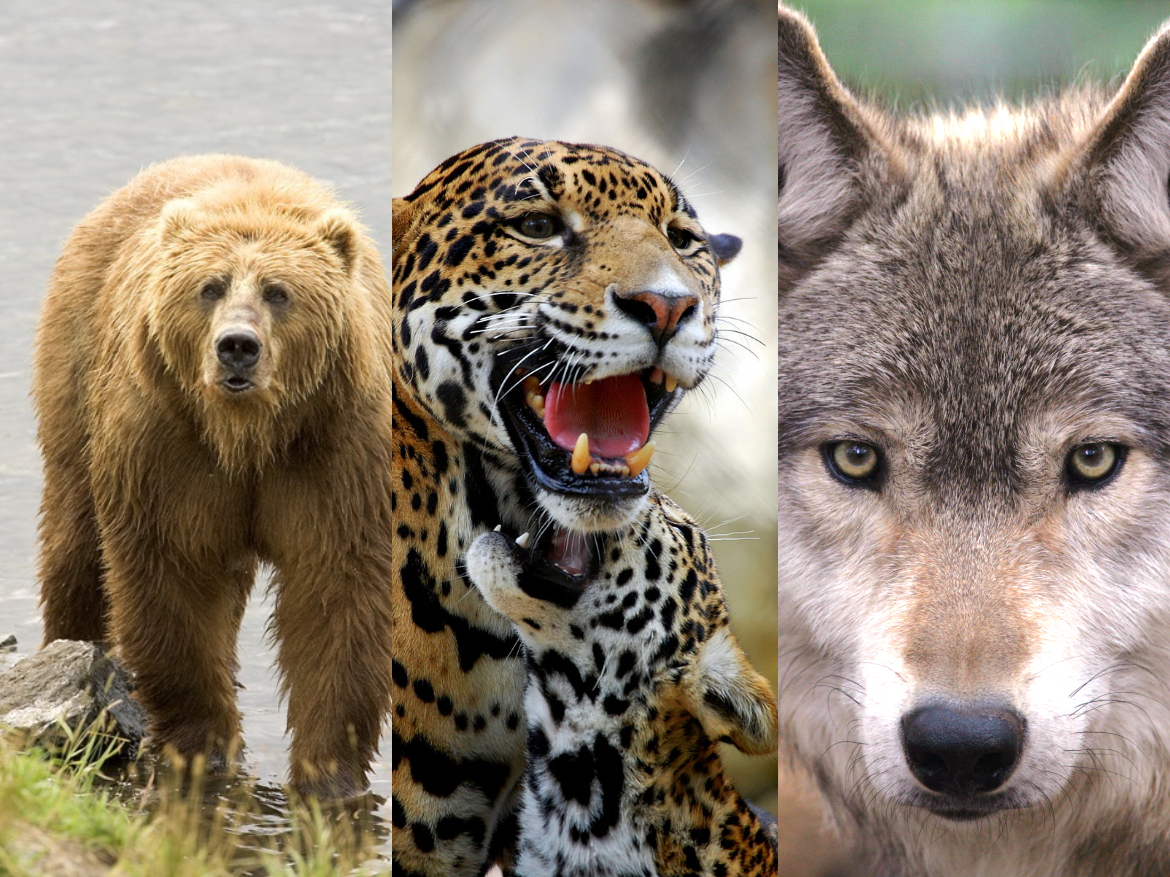
There is a lot of wildlife to see in Armenia – whether in mountains, on water and even in the air. But for many reasons, some of the species are now extinct or endangered. Probably the humanity’s impact on the environment has caused the extinction of the animals and we don’t know if we will still see them in the next decades.
Here are the top 10 wild animals that can still be found in Armenia:
#1 – Brown Bear: It is one of the largest living terrestrial members of the order Carnivora, rivaled in body size only by its close cousin, the polar bear, which is much less variable in size and slightly larger on the average. The brown bear is common in the mountain of Jermuk, Tsaghkadzor and Dilijan. But it is listed as a least concerned species by the International Union for Conservation of Nature.
#2 – Gray Wolf: It is the largest extant member of it’s family, with males averaging 43-45 kg and females 36 – 38 kg. Armenian wolves today tend to live mostly deep in the forest of Dilijan or in the mountains of Jermuk far from people so they can survive. But there are still few documented wolf attacks in local Armenians, the reason is we don’t know.
#3 – Caucasian Leopard: Also known as Persian Leopard. They were known to live on the Meghri Ridge in the extreme south of Armenia and during surveys in 2013 to 2014, camera traps recorded leopards in locations in southern Armenia, of 14 are located in the Zangezur Mountains.
#4 – Eastern Imperial Eagle: is a large species of bird of prey that breeds from southeastern Europe to western and central Asia. Most populations are migratory and winter northeastern Africa and southern and eastern Asia. But they are year round resident in Armenia.
#5 – Fox: In the wild, the typical lifespan of a fox is one to three years, although individuals may live up to ten years. Unlike many canids, foxes are not always pack animals. Typically, they live in small family groups, and you can found them anywhere in Armenia even inside of Yerevan city. There is a lot of fox that can be found in Davitashen District in Yerevan.
#6 – Vipera Raddei: It is commonly found in the forest and mountains of Armenia. Adult males can grow to a maximum total length of 99 cm and the adult females are smaller with a maximum total length of 79 cm.
#7 – Mouflon: This Mouflon sheep have reddish to dark brown, short-haired coats with dark back stripes and black ventral areas and light-colored saddle patches.The males are horned and also some of the females, while others are polled. The horn of mature ram are curved in almost one full revolution (up to 85 cm). Mouflon have shoulder heights around 0.9 m and body weights of 50 kg for male and 35 for females.
#8 – Eurasian Spoonbill: This species is almost unmistakable in most of it’s range. The breeding bird is all white except for it’s dark legs, black bill with a yellow tip, and a yellow breast patch like a pelican. it has a crest in the breeding season and you can found them in Sevan lake.
#9 – Armenian Rock Lizard: Darevskia armeniaca, commonly known as the Armenian lizard or the Armenian rock lizard is a parthenogenetic (unisexually breeding) species of Darevskia, a genus of lizards belonging to the family Lacertidae , the wall lizard. Darevskia armeniaca is native to the Armenian highland.
#10 – Armenian Gull: It is a fairly large gull species, though is on average the smallest of the “herring gull” complex. It can range from 52 to 62 cm, from 120 to 145 cm across the wings and weighs from 600 to 960 g. Among standard measurements, its wing chord is 38.5 to 45.8 cm, its bill is 4.1 to 5.6 cm and it’s tarsus is 5.7 to 6.4 cm. They are superficially similar to yellow- legged gulls but are slightly smaller with a slightly darker grey back and dark eyes.